Poetic compositions
a) Odes
- A Bonaparte liberatore, (1797). The Ode To Bonaparte the Liberator, signed Niccolò Ugo Foscolo, [the poet added, according to the custom of the age, a pen name to his own,] was first published in Bologna in May 1797. It was printed a second time in Genoa in November 1799, when Foscolo was serving with the French troops in Liguria, with the addition of a letter to Napoleon that became known as the Orazione a Bonaparte (or Dedicatoria a Bonaparte).
- A Luigia Pallavicini caduta da cavallo, (1800). The Ode To Luigia Pallavicini Fallen from Her Horse was published in 1802, but written in March 1800 when the Genoese noblewoman Luigia Pallavicini, famed for her beauty, fell from her horse while riding on the beach at Sestri Ponente and was injured (her face was disfigured). The French general Thiébault, who felt guilty about the incident because he had sold the horse to the Marchioness, included a detailed account of it in his memoirs.
- All'amica risanata, (1802). The Ode To the Recovered Friend refers to the recovery of the Milanese countess Antonietta Fagnani Arese; it was written by Ugo Foscolo in 1802 and published in 1803.
b) The sonnets
Ugo Foscolo's twelve sonnets were written between 1798 and 1803 and published between 1802 and 1803. First, in October 1802, eight sonnets and the ode A Luigia Pallavicini caduta da cavallo appeared in issue IV of Pisa's «Nuovo Giornale dei letterati», under the title «Poesie». In 1803 the poet published in Milan, under the same title «Poesie» and with a dedication to his Florentine friend Giovanni Battista Niccolini da Destefanis, the eight sonnets, prefacing three more, as well as the ode All' amica risanata. They were reissued the same year by the Milanese printer Agnello Nobile under the same title and with the addition of a twelfth sonnet.
- Non son chi fui, perì di noi gran parte (I am not who I was; a great part of us has perished). The sonnet was most probably written for Isabella Roncioni. The poet, realizing that his youthful dreams will not come true, would wish to surrender to death, but is held back by the desire for glory and love for his mother.
- Che stai? (What are you waiting for?). A sonnet in which Foscolo realizes that he is growing older and that the century is drawing to its close.
- Te nudrice alle Muse (Nurse of the Muses). A sonnet inspired by the Cisalpine Council's proposal to abolish the Latin language. The poet is outraged and will not have the victor boast of depriving Italy of her mother tongue.
- E tu ne' carmi avrai perenne vita (And in song you shall have everlasting life). The sonnet, regarded as the most important in the collection, was written in 1801 and dedicated to Florence.
- Perché taccia il rumor di mia catena. A sonnet written for Teresa Pikler or Isabella Roncioni.
- Così gl'interi giorni in luogo incerto. In this sonnet written for Roncioni, Foscolo observes that at night we revisit all the significant events of our lives, yet dwell on the most painful ones.
- Meritamente, però ch' io potei. The sonnet, inspired by Roncioni, was composed by the poet while he was in Liguria.
- Solcata ho la fronte (I have a furrowed brow). The sonnet is a self-portrait in which the poet describes himself with a high brow furrowed by wrinkles, intensely red hair, white teeth and a bowed head. A harmonious body, elegant yet simple dress, quick in his decisions, he struggles with fate and with men, and has an impulsive yet stubborn character. Foscolo concludes by saying that only through death will he attain fame and find rest.
- Alla sera (To Evening). Regarded as the finest of Foscolo's sonnets, it demonstrates the poet's adherence to the doctrines of eighteenth-century materialism.
- A Zacinto [Zakynthos (Never more shall I touch the sacred shores)]. One of Foscolo's best-known sonnets. Zakynthos, sung by the poet, is not only his birthplace but also his ideal homeland. Like other Romantic poets, Foscolo approaches classical Greece in his verses, seeing in it the embodiment of beauty and harmony.
- Alla Musa. Composed between 1802 and 1803, this poem is the first of the great sonnets.
- In morte del fratello Giovanni (On the death of my brother Giovanni). Written in 1802 after the suicide by knife of his brother Giovanni Dionisio because of a gambling debt. Though it shows influences from Catullus and Petrarch, the sonnet is one of the poet's most original. It is imbued with fraternal affection, which the poet expresses in a very intense style.
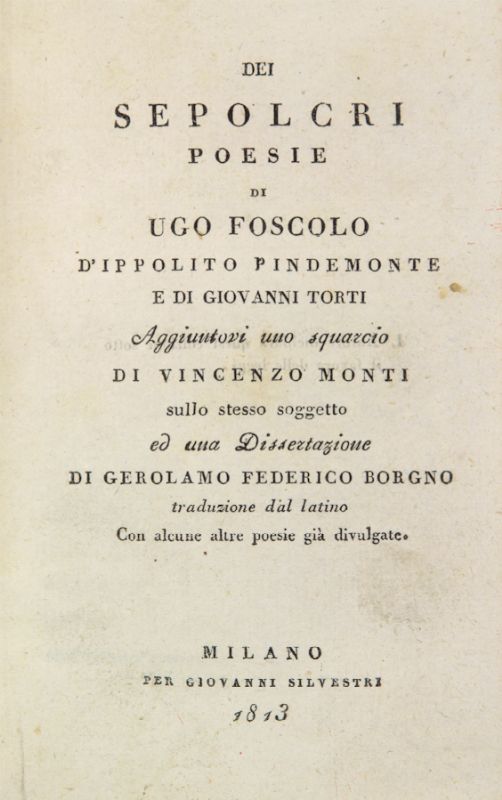
c) Dei sepolcri, (Of the Tombs, 1807). Dei sepolcri is Ugo Foscolo's most compact and complete work and was inspired by the decree regulating burial practices issued by Napoleon in June 1804 and extended to the Kingdom of Italy in 1806. The verses were written within a few months in the summer and autumn of 1806, when the poet was a guest of Countess Marzia Martinengo Provaglio at Palazzo Martinengo in Brescia, and were published in 1807 by Niccolò Bettoni's Tipografia Dipartimentale del Mella. It is likely that the idea of composing Dei sepolcri came to the poet after a discussion in Isabella Teotochi Albrizzi's literary salon with the scholar Ippolito Pindemonte, to whom the poem is dedicated.
d) Le Grazie, (The Graces, unfinished poem, 1803–1827). Le Grazie is an unfinished poetic composition dedicated to the sculptor Antonio Canova. The core of the work was written in 1803, but the actual drafting, which was never completed, began in 1812–13 and ended in the year of the poet's death, 1827.
Novels
a) Sesto tomo dell' io, romanzo autobiografico (The Sixth Volume of the Self, autobiographical novel, 1799–1801). A sketch for an autobiographical novel that remains unfinished in the form of a collection of fragments. It is regarded as the boldest attempt to reform the Italian novel. In the preface Foscolo writes «This volume comprises the twenty-third year, from 4 May 1799 to 4 May 1800», declaring his intention to speak of the twenty-third year of the author-protagonist's life and implying that the novel forms part of a larger work that would cover his entire life.
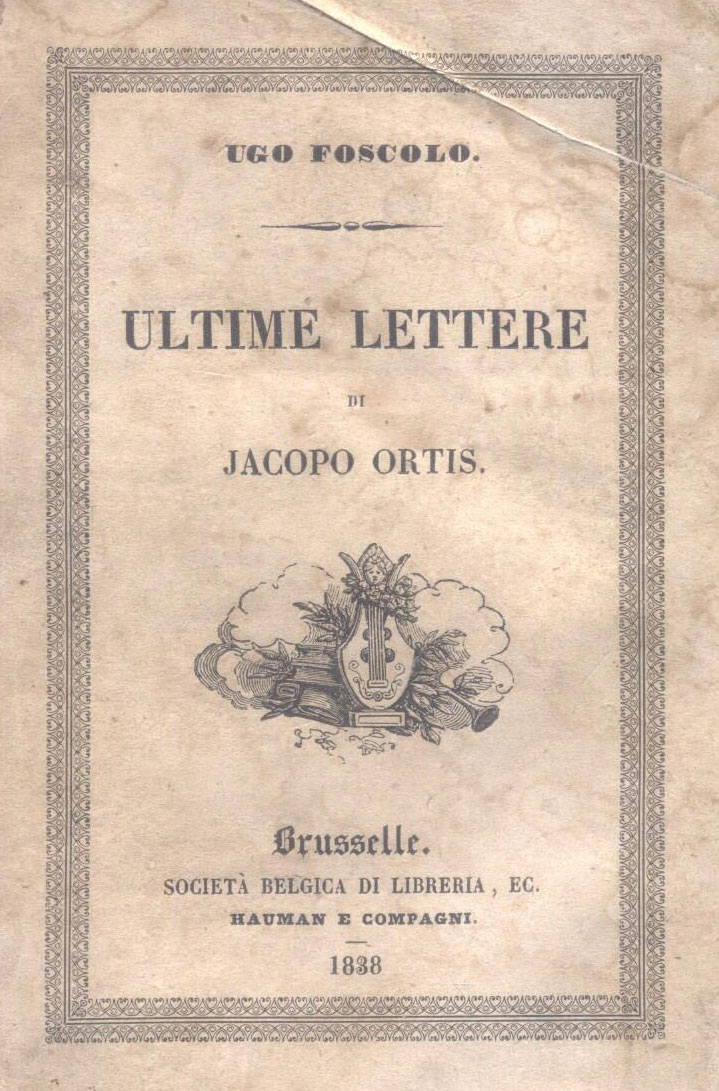
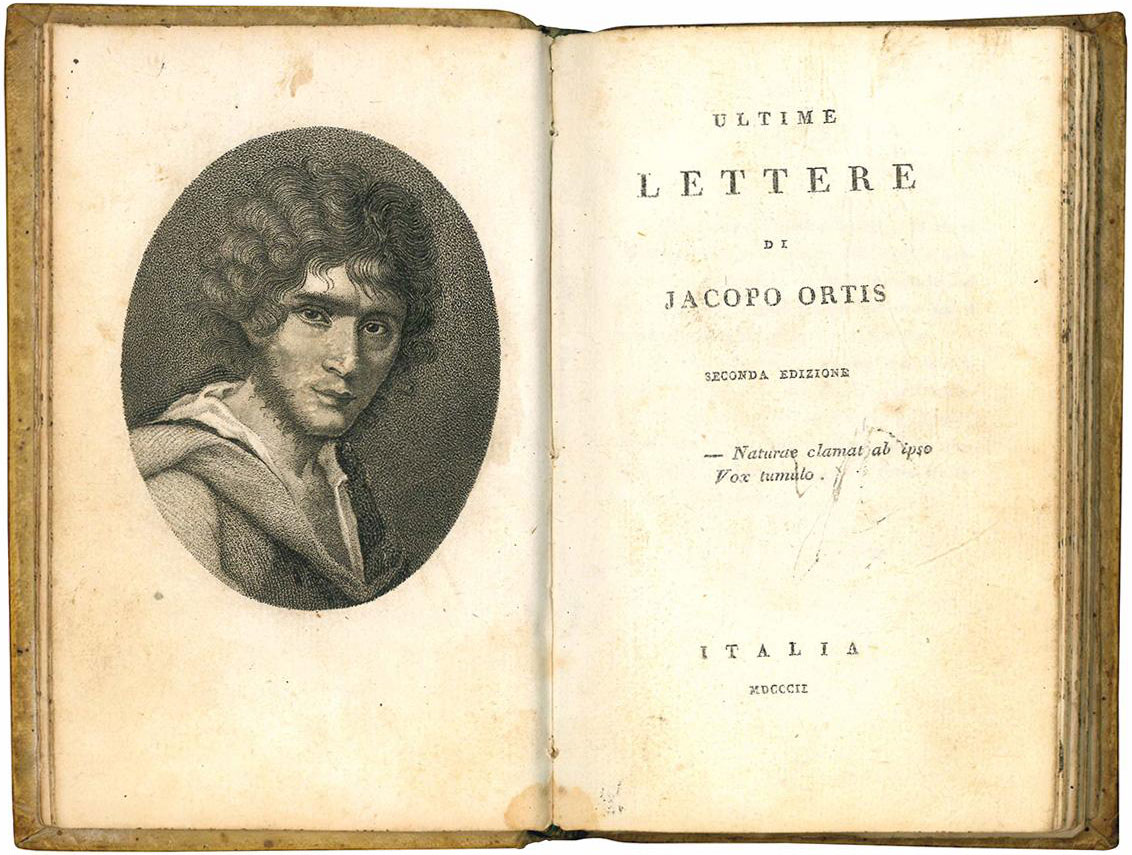
b) Ultime lettere di Jacopo Ortis, romanzo epistolare, 1802–1803 (The Last Letters of Jacopo Ortis, epistolary novel, 1802–1803). An epistolary novel, a form that enjoyed great success in eighteenth-century Europe. The story consists of a series of letters that the protagonist writes to his friend Lorenzo Alderani. Foscolo drew inspiration from Goethe's The Sorrows of Young Werther (1774) and Rousseau's Nouvelle Héloïse.
Tragedies
- Tieste, tragedia (1795) [Thyestes]. Foscolo composed the tragedy Thyestes most probably in 1795. The work was first performed at the Teatro Sant' Angelo in Venice on 4 January 1797 by Giuseppe Pellandi's company and met with great success. The text of the tragedy, revised and corrected, was included in April in volume 10 of Teatro moderno, the periodical of the Venetian Antonio Fortunato Stella. The tragedy consists of 1,401 hendecasyllabic lines and is divided into five acts. The plot centres on the rivalry between Atreus, king of Argos, and his brother Thyestes.
- Edippo, tragedia (1795–1796?) – attribuita (Oedipus, a tragedy attributed to Foscolo). A prose draft of a tragedy dedicated to Oedipus is preserved in the Biblioteca Labronica in Livorno. In 1978 a manuscript entitled the tragedy Edippo by Wigberto Rivalta was attributed to Foscolo by Mario Scotti. The manuscript is in Rome, among papers that belonged to Silvio Pellico. According to Scotti, the attribution rests on textual and structural evidence. His claims, however, have not convinced all scholars, and debate over the corpus of the poet's tragedies remains open.
- Ajace, tragedia, 1810–1811 (Ajax). A tragedy in five acts composed by Foscolo between 1810 and 1811. It was performed at La Scala in Milan on 9 December 1811 with moderate success. The tragedy, which was repeated only once because the police found allusions to Napoleon Bonaparte in the text and banned further performances, remained unrevised and was first published in Naples in 1828, censored by Urbano Lampredi.
- Ricciarda, tragedia (1813). The tragedy La Ricciarda was composed between September 1812 and early June of the following year. It was first performed in Bologna on 17 September 1813 by Salvatore Fabbrichesi's company and published in 1820 in London by John Murray with a dedication to Lord John Russell.
Other writings
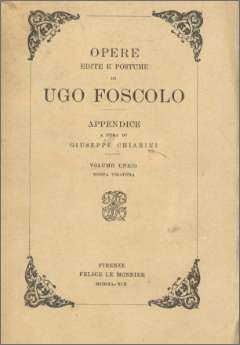
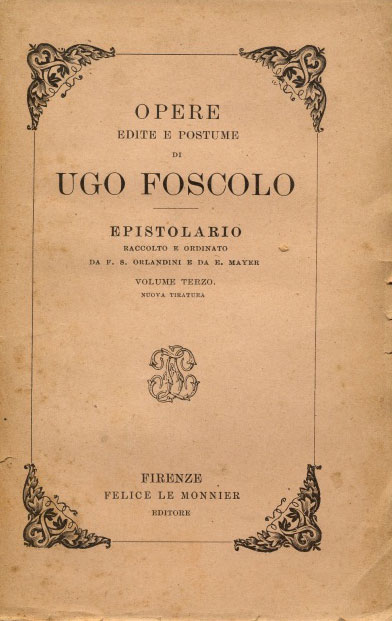
- Epistolario (1794–1827) [Correspondence]. Foscolo's correspondence is among the richest and most interesting in Italian literature.
- Esame su le accuse contro Vincenzo Monti (1798). Examination of the charges against Vincenzo Monti.
- Discorso su la Italia (1799) [Discourse on Italy].
- Orazione a Bonaparte pel Congresso di Lione (1802) [Oration to Bonaparte for the Congress of Lyons].
- Chioma di Berenice, traduzione della versione catulliana del carme di Callimaco (1803). The Lock of Berenice, a translation of Catullus's version of Callimachus's poem.
- Della poesia, dei tempi e della religione di Lucrezio (1803) – frammenti. Fragments on the poetry, the age and the religion of Lucretius. Titus Lucretius Carus (94 BC – 15 October 55 BC) was a Roman poet and philosopher. His only known work is the extensive philosophical poem De rerum natura ("On the Nature of Things"), 7,415 lines of Epicurean theme.
- Viaggio sentimentale, traduzione del romanzo di Laurence Sterne, iniziata nel (1805), pubblicata nel (1813) dall'editore Molini, an Italian translation of Laurence Sterne's novel «A Sentimental Journey Through France and Italy», begun in 1805 and published in 1813 by the publisher Molini.
- Notizia intorno a Didimo Chierico. Consisting of sixteen short chapters, this work served as the introduction to the translation of Laurence Sterne's «Viaggio sentimentale». The «notes» present the eccentric figure of Didimo Chierico, a pseudo-autobiographical substitute for Foscolo, through whom the author ironically revisits his experiences and, in particular, the character of Jacopo Ortis in the novel of that name.
- Esperimento di traduzione della Iliade di Omero, comprendente la traduzione del primo libro del poema omerico (1807). An attempt at an Italian translation of Book I of the Iliad.
- Dell' origine e dell' ufficio della letteratura (1809). Foscolo's inaugural address at the University of Pavia, where he taught rhetoric for a time, delivered on 22 January 1809, «On the Origin and Function of Literature», focuses on the relationship between literature and society. According to Foscolo, art has above all a social function: it is for art to create a balance among the various social forces, tempering their excesses and passions. This is possible thanks to the power of the poetic word, which can create extraordinary worlds, console against the ills of life and at the same time enable people to know the truth. Literature and poetry must therefore use an intelligible language capable of bringing truth to the hearts of the powerful and the weak alike.
- Didymi Clerici, Prophetae minima Hypercalypseos liber singularis. A work in Latin verse. Foscolo began composing it in Milan in 1810. He published it after fleeing to Switzerland, in Zurich (June 1816) with the booksellers Füssli, indicating another place and date (Pisa, 1815). Didimo Chierico is both its author and its protagonist.
- Ragguaglio d'un'adunanza dell'Accademia de' Pitagorici (1810). Account of a meeting of the Academy of the Pythagoreans, published under the pseudonym Didimo Chierico.
- Discorso sul testo della Divina Commedia (1818). Commentary on the text of the Divine Comedy. Foscolo completed only the commentary on the Inferno, now held in the Biblioteca Labronica in Livorno.
- Saggio sulla letteratura contemporanea in Italia (1818). Essay on contemporary literature in Italy.
- Essays on Petrarch (1823). Essays on Petrarch, published by J. Murray.
- Discorso storico sul testo del Decamerone di messer Giovanni Boccaccio premesso all'edizione delle Cento novelle fatta in Londra. Lugano, G. Ruggia e C., 1828. Historical introduction to the edition of Boccaccio's Decameron.
- Della nuova scuola drammatica in Italia, [unfinished work].
- Lettera apologetica (1825). Apologetic letter. The text was intended to be published as a preface to the edition of Dante's Divine Comedy that Foscolo planned to prepare in 1824 for the publisher Pickering and which was never completed. The dedication «To the editors of the Divine Comedy in Padua» was meant to justify the arbitrary placement as a preface of a text that presented political and autobiographical elements concerning Foscolo incompatible with an edition of Dante. The unfinished text of the Apologetic Letter was later found by Giuseppe Mazzini in 1840, when, exiled in London, he contacted the publisher Pickering to complete his search for Foscolo's unpublished works, and was published by Mazzini in Lugano in 1844.
.jpg)